Choosing an Automotive Ethernet Gateway is a network decision, not merely a purchasing task. It affects data flow, safety, diagnostics, and future vehicle upgrades. A gateway may sit behind the dashboard, yet it connects cameras, sensors, domain controllers, and legacy CAN or LIN networks.
Dr. Zeljko Popovic, a recognized automotive Ethernet specialist, has expressed the central design principle clearly: “Automotive Ethernet is an enabler, not an end in itself.” That reminder matters. Higher bandwidth alone does not guarantee a better vehicle architecture. Engineers must examine port speed, protocol support, time-sensitive networking, cybersecurity features, latency, thermal behavior, and software update options. Small details matter. A poorly matched gateway can create delays during camera streaming or complicate fault isolation in a service bay.
This guide explains how to compare gateway options with practical engineering discipline. It considers real traffic conditions, not impressive laboratory numbers. It also examines electromagnetic compatibility, redundancy, diagnostics, and integration with existing electronic control units. Experience shows that compatibility questions often appear late. That is a costly mistake. A gateway should support today’s vehicle platform while leaving room for zonal architectures and higher data volumes.
There is no universal choice. A premium gateway may be excessive for a simple body network. A low-cost device may become restrictive after one software revision. The uncomfortable truth is that specifications can look complete while important assumptions remain untested. Careful selection requires evidence, supplier transparency, and realistic validation on the target vehicle.
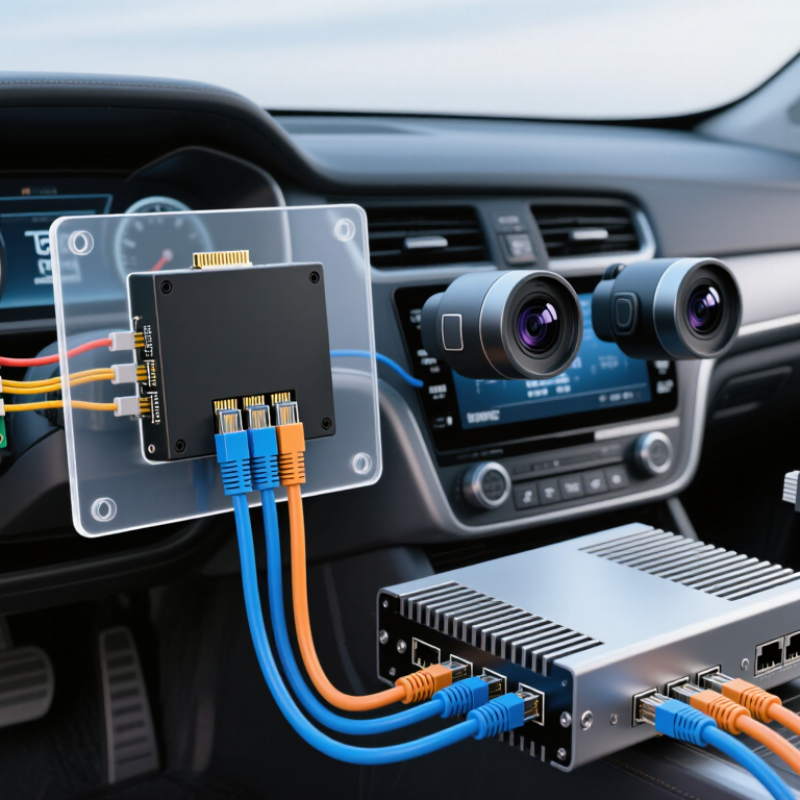
An automotive Ethernet gateway is the traffic controller between high-speed Ethernet domains and legacy vehicle networks. It translates protocols, filters messages, and enforces timing across zones. That role is practical, not decorative. During bench testing, a blocked diagnostic frame can expose a poor routing rule within seconds. It can also stop one noisy segment from disturbing body-control communication. MarketsandMarkets reported that the automotive Ethernet market could grow from about USD 2.6 billion in 2024 to USD 6.2 billion by 2029.
The gateway must manage more than bandwidth. It should support deterministic forwarding, time synchronization, diagnostics, access control, and secure software updates. A 2024 KPMG automotive executive survey identified software-defined vehicles as a major development priority. That shift increases gateway responsibility. Engineers must map message paths before selecting hardware. They should measure latency under peak traffic, not only during clean demonstrations. A gateway may pass every functional test and still fail when cameras, radar, and diagnostics compete for capacity. That is an uncomfortable design gap.
Tips: Create a signal-flow table first. Record source, destination, protocol, latency target, and failure response. Test disconnected links and malformed traffic. Keep safety-critical paths isolated. Review the rules with software, network, and functional-safety engineers. Small omissions matter. A missing timestamp can complicate fault analysis later. The design may look efficient, but real vehicles are rarely quiet.
Choosing an automotive Ethernet gateway starts with a clear map of the vehicle’s networks. List each domain, including body control, powertrain, safety, and infotainment. Record whether each system uses Ethernet, CAN, LIN, or another protocol. Do not rely on old wiring diagrams alone. In real projects, connectors and software routes may differ from documentation.
Next, trace the data flow between sensors, controllers, diagnostic tools, and cloud services. Mark data direction, message frequency, payload size, and timing limits. A camera stream may require high bandwidth, while a door status signal needs predictable delivery. Identify traffic that must remain isolated. Also check whether the gateway supports time synchronization, filtering, diagnostics, and secure software updates. These details often matter more than peak throughput.
Tips: Draw the network on one page. Use arrows for every data path. Test peak traffic, not average traffic. Ask engineers to verify the map beside the vehicle. Small mistakes become expensive later. I have found that teams sometimes overestimate bandwidth and underestimate latency. That assumption deserves review. Choose a gateway that matches today’s requirements, but leave measured capacity for future sensors and changing communication patterns.
Choosing an automotive Ethernet gateway starts with standards, not a product label. IEEE 802.3bw supports 100 Mb/s over single-pair cabling, while IEEE 802.3bp supports 1 Gb/s. IEEE 802.3ch extends this range to 2.5, 5, and 10 Gb/s. A 2024 automotive Ethernet market report forecasts growth from roughly $2.8 billion to $6.5 billion by 2029. That growth reflects rising data demands, not automatic compatibility.
Check every port carefully. Count Ethernet links, CAN or CAN FD channels, LIN interfaces, and diagnostic connections. Then examine the internal switch fabric. Eight 1 Gb/s ports can overwhelm a weak processor. It happens in prototypes. Measure sustained throughput, not only the headline speed. Leave practical headroom for camera bursts, software updates, and diagnostic traffic.
Protocol support matters just as much. Look for VLAN tagging, Quality of Service, TSN, SOME/IP, DoIP, and secure time synchronization. Confirm whether the gateway translates messages or merely forwards frames. The distinction is important. A gateway may support 10 Gb/s physically but still process legacy CAN traffic slowly. Test latency under mixed loads, including 100BASE-T1 and 1000BASE-T1 links. I would also request packet-loss results at high temperature. Many datasheets omit that detail. That omission deserves scrutiny.
| Gateway Profile | Automotive Ethernet Standard | Ethernet Port and Topology | Nominal Ethernet Bandwidth | Legacy or Edge Interfaces | Common Protocol Support | Time-Sensitive Networking | Typical Automotive Role | Key Selection Considerations |
|---|---|---|---|---|---|---|---|---|
| Classic CAN to Ethernet Gateway | IEEE 802.3bw 100BASE-T1 | Single-pair automotive Ethernet; point-to-point full-duplex link | 100 Mb/s | Classic CAN LIN | CAN ISO-TP UDS IPv4 TCP/UDP DoIP | Usually basic Ethernet switching and VLAN support; TSN capability depends on the gateway implementation | Connecting body, comfort, chassis, or diagnostic CAN networks to an Ethernet backbone | A practical choice when existing CAN traffic must be transported without requiring gigabit throughput. |
| Multi-Bus CAN FD Gateway | 100BASE-T1 or 1000BASE-T1 uplink | One or more single-pair Ethernet ports; point-to-point links | 100 Mb/s or 1 Gb/s uplink | Classic CAN CAN FD LIN | CAN FD ISO-TP UDS SOME/IP DoIP | May support IEEE 802.1Q VLAN, frame prioritization, and selected TSN functions | Domain controller or central gateway aggregating multiple low-speed vehicle networks | Check the number of CAN FD channels, receive/transmit queue depth, filtering rules, and maximum simultaneous bus load. |
| 100BASE-T1 Domain Gateway | IEEE 802.3bw 100BASE-T1 | Multiple single-pair Ethernet ports; switched point-to-point star or line segments | 100 Mb/s per link | CAN CAN FD LIN FlexRay | Ethernet II 802.1Q VLAN SOME/IP DoIP UDS | Suitable for traffic prioritization; support for 802.1AS/gPTP and other TSN features must be verified | Body, comfort, powertrain, chassis, or infotainment domain aggregation | Choose the port count and switching capacity according to the number of downstream ECUs and expected multicast traffic. |
| Gigabit Automotive Ethernet Backbone Gateway | IEEE 802.3bp 1000BASE-T1 | Single-pair automotive Ethernet; point-to-point full-duplex backbone links | 1 Gb/s per link | CAN FD LIN FlexRay | SOME/IP DoIP IPv4/IPv6 TCP/UDP 802.1Q | Common platform for 802.1AS/gPTP, traffic shaping, frame preemption, and other TSN functions when implemented | High-performance central gateway, zonal backbone, camera, radar, lidar, and infotainment aggregation | Confirm PHY reach, electromagnetic compatibility requirements, switch fabric capacity, and whether hardware time synchronization is available. |
| 10BASE-T1S Edge Gateway | IEEE 802.3cg 10BASE-T1S | Single-pair Ethernet; supports point-to-point and multidrop segments | 10 Mb/s shared or point-to-point segment rate | Low-speed sensors Actuators Legacy I/O | Ethernet II IPv4 UDP/TCP SOME/IP Diagnostics | TSN support is implementation-dependent; multidrop scheduling and network configuration require careful validation | Replacing selected low-speed point-to-point or multidrop vehicle networks with Ethernet | Evaluate segment loading, multidrop node count, fault isolation, EMC performance, and software support before deployment. |
| FlexRay to Ethernet Gateway | 100BASE-T1 or 1000BASE-T1 uplink | Single-pair Ethernet uplink with one or more FlexRay channels | 100 Mb/s or 1 Gb/s uplink | FlexRay CAN FD CAN | FlexRay ISO 17458 SOME/IP UDS DoIP ISO-TP | Ethernet-side synchronization may be available; FlexRay cycle and slot timing remain separate constraints | Migration or integration of time-triggered chassis and powertrain networks with Ethernet domains | Verify FlexRay channel count, cold-start behavior, cycle timing, gateway latency, and deterministic frame translation. |
| Diagnostic and Service Gateway | 100BASE-T1 or 1000BASE-T1; external service Ethernet may use standard Ethernet PHYs | Vehicle Ethernet ports plus CAN/CAN FD and optional LIN interfaces | 100 Mb/s or 1 Gb/s vehicle-side link | CAN CAN FD LIN | DoIP ISO 13400 UDS ISO 14229 ISO-TP ISO 15765-2 TLS | Not normally selected for time-critical control traffic; secure routing and access control are primary requirements | Vehicle diagnostics, software download, calibration, service-tool access, and secure maintenance | Prioritize secure boot, firewalling, certificate handling, diagnostic routing, access authorization, and update recovery mechanisms. |
| TSN-Capable Zonal Gateway | 100BASE-T1 and/or 1000BASE-T1 with an automotive Ethernet switch | Multiple switched single-pair Ethernet ports; zonal star or ring architecture | 100 Mb/s to 1 Gb/s per link | CAN FD LIN Sensor I/O | SOME/IP DoIP 802.1Q VLAN IPv4/IPv6 gPTP | May support IEEE 802.1AS, 802.1Qbv, 802.1Qav, 802.1Qbu, and 802.1CB; exact feature coverage varies | Zonal vehicle architecture carrying control, sensor, diagnostics, and infotainment traffic | Select based on latency and jitter targets, redundant-path requirements, time synchronization accuracy, queue design, and cybersecurity functions. |
Assess Security, Reliability, Diagnostics, and Software Update Features
A gateway connects vehicle networks, so its security design matters. Ask how it authenticates devices and protects data moving between domains. Look for secure boot, signed software, and controls that limit access to critical functions. These features reduce risk, but they do not replace careful system-level testing. Ask how security events are recorded and reviewed.
Reliability shows up under ordinary strain. Check operation across expected temperatures, vibration, and voltage changes, then examine recovery behavior after a network interruption. A gateway should report faults clearly and preserve essential communication when a connected module stops responding. Test it in a representative vehicle setup. Bench results alone can miss wiring and integration problems.
Diagnostics should help technicians trace a fault without guesswork. Useful logs include timestamps, network status, and error details that can be exported for analysis. Software updates deserve the same scrutiny. Confirm that updates can be verified, interrupted safely, and rolled back if something fails. How often will the process be tested? That question is easy to overlook. The best choice depends on the vehicle’s architecture, service workflow, and support plan—not a feature checklist alone.
How to Choose an Automotive Ethernet Gateway?
A gateway should fit the vehicle’s current network and its likely next generation. Check protocol support, port count, latency, diagnostics, and whether the device can route traffic between existing CAN or LIN segments and Ethernet. IEEE 802.3ch defines single-pair automotive Ethernet rates of 2.5, 5, and 10 Gb/s, giving engineers room to plan for higher data loads. That does not mean every link needs 10 Gb/s. Measure real traffic, including bursts from cameras and sensors, then leave practical headroom. Bench tests often reveal awkward bottlenecks.
Scalability also depends on software and physical integration. Confirm that the gateway supports the required time synchronization, network management, security controls, and update process. Check conformance against applicable IEEE specifications and automotive profiles, including OPEN Alliance test requirements where relevant. Ask for test evidence, not just a compliance claim. A useful review includes connector fit, thermal behavior, power draw, and fault recovery in the intended installation location.
Compare total ownership cost, not only purchase price. Include integration engineering, harness changes, validation, licensing, power consumption, and service effort over the vehicle program. A cheaper unit may demand extra engineering hours. That cost can hide. Request a lifecycle estimate with assumptions stated, and challenge optimistic figures; early estimates are often imperfect. Track the cost of adding ports or bandwidth later, too, since a modest initial saving can become an expensive redesign.
It controls traffic between high-speed Ethernet domains and older vehicle networks. It translates protocols, filters messages, and manages timing. It can isolate noisy communication segments. That protection matters.
Common single-pair Ethernet rates include 100 Mb/s, 1 Gb/s, 2.5 Gb/s, 5 Gb/s, and 10 Gb/s. Higher speed does not guarantee compatibility. Measure actual traffic before choosing hardware.
Count Ethernet, CAN, CAN FD, LIN, and diagnostic connections. Review the internal switching capacity, not only the connector count. Eight fast ports can overload a weak processor. Leave room for future expansion.
Consider VLAN tagging, Quality of Service, time-sensitive networking, service-based communication, diagnostics over Ethernet, and secure time synchronization. Confirm whether the gateway translates messages or only forwards frames. That difference is important.
Test latency during peak traffic from cameras, sensors, and diagnostics. Measure sustained throughput, packet loss, and recovery after disconnected links. Include malformed traffic and high-temperature conditions. Clean demonstrations can mislead.
Map every signal path before selecting hardware. Record the source, destination, protocol, latency target, and failure response. Isolate safety-critical traffic from noisy segments. Small omissions matter.
Check connector fit, thermal behavior, power consumption, update procedures, and fault recovery. Verify applicable technical specifications and conformance evidence. Ask for test results, not only compliance claims. Review the installation location carefully.
Include hardware, integration labor, harness changes, validation, licensing, power use, and service effort. Estimate the future cost of extra ports or bandwidth. A cheaper gateway may require more engineering hours. My early estimate could still be wrong.
Choosing an Automotive Ethernet Gateway begins with understanding its role in the vehicle: it connects network domains, routes data, and helps different electronic systems communicate reliably. Start by mapping the vehicle’s networks, the information each system sends and receives, and the timing and performance each data flow requires. This foundation helps determine which gateway capabilities are actually necessary.
Compare available standards, ports, bandwidth, and protocol support against the vehicle’s current architecture and future needs. Then assess security protections, reliability, diagnostic tools, and software update capabilities, since these affect long-term operation and maintenance. Finally, verify that the gateway can integrate with existing components, scale as vehicle systems evolve, and meet applicable technical and compliance requirements. Consider the total cost of ownership—including integration, testing, support, and future upgrades—rather than focusing on the purchase price alone. A careful evaluation helps select a solution that fits both present requirements and planned development.