- ISO 9001:2015 Certified Manufacturing — Canada
- Engineering Support Since 1991
Explore high-precision I/O modules, power convertors, discrete fieldbus units, and heavy-duty position automation components validated for extreme industrial applications.
In modern off-highway vehicles, industrial robotics, automated construction machinery, and precision energy control systems, position sensors act as the central nervous system. They provide essential real-time feedback on linear displacement, angular orientation, dynamic tilt, and stroke position. Sourcing high-reliability position transducers is no longer just a hardware procurement activity; it is a core architectural decision affecting dynamic safety, machine longevity, and overall operational efficiency.
As industrial automation shifts toward Industry 4.0 and autonomous operations, position sensors must do more than output basic raw analog signals. Modern engineering demands direct integration with vehicle fieldbuses via SAE J1939, CANopen, CAN FD, and Automotive Ethernet protocols. Selecting a premier manufacturing partner requires assessing non-linearity errors, thermal coefficient drift, vibration tolerance, and ingress protection against high-pressure washdowns (IP67/IP68/IP69K).
To assist procurement directors and chief automation engineers in matching application targets with optimal sensor architectures, the evaluation matrix below highlights the core performance parameters across primary position-sensing technologies.
| Sensing Technology | Primary Operating Principle | Typical Accuracy & Linearity | Ingress / Shock Resilience | Standard Communication Protocols | Target Machine Applications |
|---|---|---|---|---|---|
| LVDT (Linear Variable Differential Transformer) | Electromagnetic inductive coupling without physical contact sliding. | ±0.1% to ±0.25% FS | Exceptional (Hermetic seal up to IP69K, 100g shock) | 0-10V, 4-20mA, Modbus RTU | Hydraulic cylinder feedback, turbine valves, aerospace actuators. |
| Magnetostrictive Linear Transducer | Time-of-flight measurement of sonic wave generated by magnetic interaction. | < ±0.01% FS (Up to 2μm resolution) | High (In-cylinder pressure rated to 350 bar continuous) | SAE J1939, CANopen, SSI, EtherCAT | Heavy hydraulic excavators, injection molding, steel mill machinery. |
| Hall-Effect Rotary & Linear | Semiconductor voltage changes in response to magnetic field variance. | ±0.5% to ±1.0% FS | Encapsulated Solid-State (Vibration immune) | Analog Ratiometric, PWM, CANbus | Throttle foot pedals, steering angle units, joystick pivots. |
| Dual-Axis Dynamic Inclinometer | MEMS accelerometer combined with gyroscopic rate filtering (IMU). | ±0.1° dynamic accuracy across wide temp range | Fully Potted IP67/IP69K Enclosures | SAE J1939, CANopen, RS-485 | Crane boom angle, agricultural leveling, mining chassis tilt control. |
| Optical Encoders (Absolute/Incremental) | Light interruption through high-precision coded grating disc. | Ultra-High (< 16-bit to 24-bit resolution) | Moderate to High (Requires sealed optical housing) | Profibus, PROFINET, EtherNET/IP, SSI | CNC spindles, robotics joints, automated warehouse AGVs. |
Combining 30+ years of Canadian engineering heritage with global manufacturing standards for harsh-environment machine control.
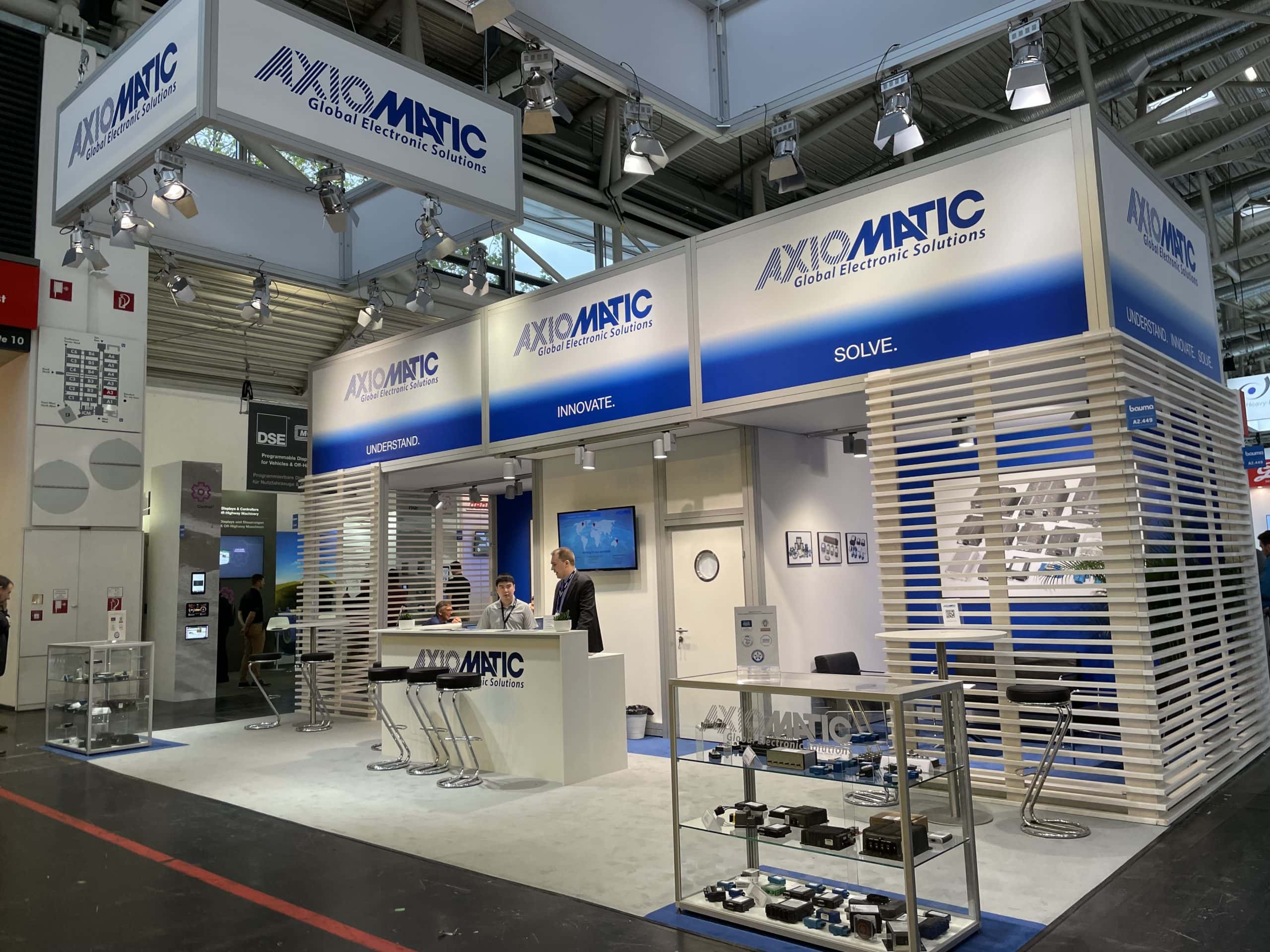
Founded in 1991, Axiomatic Technologies Corporation has established itself as a premier global OEM design and manufacturing entity specializing in rugged electronic controls, hydraulic valve drivers, DC-DC power converters, and high-precision position and tilt sensors.
Operated under an ISO 9001:2015 certified quality system in Canada, Axiomatic maintains dedicated R&D engineering units in Canada and Finland, supported by international sales operations in the United States and Australia. The company's engineering strength lies in customizing control hardware and firmware to match strict vehicle network parameters, severe thermal shock requirements, and heavy EMI/EMC compliance environments.
Standardized manufacturing, rigorous internal quality control, full component traceability.
Active participant in standardizing CANopen protocol profiles for off-highway vehicles.

Direct compliance with SAE J1939 protocols, automotive EMC immunity, and mechanical shock limits.
Axiomatic position, incline, and valve control solutions are engineered specifically for working machines operating in the world's toughest sectors.

Hydraulic excavators, loaders, agricultural tractors, and forestry harvesters needing continuous stroke feedback under heavy vibration.

Solar tracking positioning, wind turbine pitch actuators, steam valve control, and oilfield extraction monitoring systems.

Electronic governor positioning, fuel valve actuators, EGR position monitoring, and thermal protection management modules.

Refuse trucks, fire apparatus leveling, emergency vehicle steering geometry sensing, and municipal utility cranes.
Custom signal conditioning, protocol bridging between legacy analog transducers and modern CANbus vehicle backbones.
A comprehensive analysis of leading international position sensor vendors, highlighting technical specializations, manufacturing strengths, and exporting capabilities.
Core Specialty: Rugged CANbus-integrated position sensors, inclinometers, hydraulic valve controllers, and custom OEM electronic control units (ECUs).
Competitive Advantage: Specializes in harsh off-highway and heavy industrial environments. Offers factory-customized firmware, high EMC immunity, sealed IP69K housings, and seamless SAE J1939 / CANopen integration.
Core Specialty: LVDTs, linear potentiometers, piezoelectric vibration and displacement sensors, conductive plastic encoders.
Competitive Advantage: Vast global supply chain footprint, comprehensive automotive-grade sensor portfolio, and massive R&D backing for high-volume automotive and aerospace applications.
Core Specialty: Non-contact rotary magnetic encoders, linear potentiometric transducers, magnetostrictive position sensors.
Competitive Advantage: Pioneers in conductive plastic technology and touchless rotary measurement, offering long life span (>100 million operations) for industrial process engineering.
Core Specialty: Magnetostrictive linear position sensors designed for in-cylinder hydraulic feedback.
Competitive Advantage: High-precision measurement in high-pressure hydraulic cylinders, offering sub-micron resolution, resistance to fluid contamination, and high mechanical pressure ratings.
Core Specialty: Inductive distance sensors, magnetic field positioning systems, IO-Link linear transducers.
Competitive Advantage: Strong leader in smart factory integration, offering full IO-Link protocol stacks for real-time condition monitoring and factory automation setups.
Core Specialty: Laser distance measurement sensors, optical encoders, linear measurement sensors for logistics automation.
Competitive Advantage: Exceptional optical accuracy over long distances, high-speed Ethernet communication protocols, and integrated machine vision capabilities.
Core Specialty: Magnetostrictive and potentiometric linear transducers for plastic processing machinery.
Competitive Advantage: Strong customization capabilities for European machine builders, featuring robust immunity to ambient temperature swings and mechanical wear.
Core Specialty: Inductive sensors, 3D smart position sensors, vehicle inclination sensors for mobile hydraulics.
Competitive Advantage: User-friendly modular mounting options, rugged CANbus mobile vehicle sensors, and cost-effective standard catalog lines.
Core Specialty: Hall-effect position ICs, heavy-duty linear position transducers, aerospace rotary sensors.
Competitive Advantage: High-reliability sensors qualified for commercial aviation, defense vehicles, and critical medical infrastructure.
Core Specialty: Non-contacting torque and angle position sensors, precision potentiometers, optical encoders.
Competitive Advantage: Compact OEM form factors, competitive volume pricing for automotive steering systems, and reliable resistance element formulation.
System integrators, original equipment manufacturers (OEMs), and technical procurement directors face rapidly changing technical specifications when sourcing position sensors. Understanding these market shifts ensures long-term component availability and avoids redesign cycles.
Traditional ratiometric voltage (0.5V-4.5V) and current loop (4-20mA) interfaces are increasingly being replaced by CAN FD, Automotive Ethernet, and IO-Link networks. Digital networks provide robust noise immunity across extended wire harnesses and allow real-time diagnostic telemetry, including internal sensor temperature, vibration monitoring, and fault reporting.
Modern mobile equipment demands combined tilt and stroke measurement. Dynamic inclinometers now integrate MEMS accelerometers with gyroscopic rate sensors running sensor-fusion algorithms (Kalman filtering). This eliminates errors caused by rapid machine acceleration, centrifugal forces, and structural vibrations during excavator or crane movements.
Global regulatory bodies require higher functional safety standards for heavy machinery operating near human personnel. Procurement specifications now prioritize dual-channel position sensors featuring redundant sensing elements (rATIOMETRIC or dual-CAN) certified to meet Performance Level d (PLd) under ISO 13849 or SIL2 under IEC 61508.
Industrial components are exposed to aggressive washdown chemicals, continuous mud exposure, salt spray, and extreme temperature cycling (-40°C to +85°C). Advanced potting materials (polyurethane and epoxy encapsulation) paired with stainless steel or heavy-duty aluminum housings are standard requirements for heavy equipment exports.
As industrial machines transition toward full autonomy and electric powertrains, position sensor hardware must adapt to new electromagnetic and operational demands:
Expert engineering answers addressing protocol compatibility, custom packaging, environmental compliance, and quality verification.
For mobile off-highway equipment (construction, mining, agriculture), SAE J1939 and CANopen are the primary industry standards. They provide high noise immunity, standardized message frames, and direct compatibility with vehicle displays and main controllers. For stationary industrial machinery, IO-Link, PROFINET, EtherCAT, or SSI (Synchronous Serial Interface) are preferred for high-speed synchronization.
A linear potentiometer relies on a physical wiper sliding across a resistive track, making it vulnerable to mechanical wear, contact chatter, and fluid contamination over time. Non-contact magnetostrictive sensors utilize a magnetic field interaction to measure position via acoustic pulse timing. Because there are no friction contact points, magnetostrictive sensors offer virtually unlimited mechanical service life, higher precision, and immunity to high vibration.
Yes. Axiomatic Technologies offers complete custom OEM engineering services worldwide. This includes designing tailored printed circuit board assemblies (PCBA), custom enclosure geometry, mating connector preferences (Deutsch, M12, Ampseal), and application-specific firmware algorithms to match your machine's exact mechanical footprint and CAN network definitions.
Sensors mounted on open machine chassis or hydraulic booms should carry a minimum rating of IP67 (immersion protection). However, for equipment subjected to high-pressure hot-water washdowns (such as mining, agricultural, or food-grade machinery), IP69K sealing is essential to prevent moisture ingress across seal interfaces.
Thermal variance causes electrical resistance shifts and mechanical expansion within sensor elements. High-grade industrial sensors incorporate internal temperature compensation circuits or microprocessor-based lookup tables that correct signal drift dynamically across extended operating windows (typically -40°C to +85°C or +105°C).
Buyers should confirm that the manufacturer operates under an ISO 9001:2015 certified quality management system. Furthermore, verify compliance with CE, UKCA, REACH, RoHS, and industry-specific certifications such as SAE J1939 standards or CiA (CAN in Automation) device profiles for fieldbus interoperability.
Consult with our engineering and technical sales teams to evaluate your machine architecture, select the right CANbus transducer platform, or request a custom OEM solution engineered to your exact specifications.
Contact Us